
How Drone Startups Are Leading the Make in India Vision
October 27, 2025
What makes a training drone effective to build pilot skills?
November 28, 2025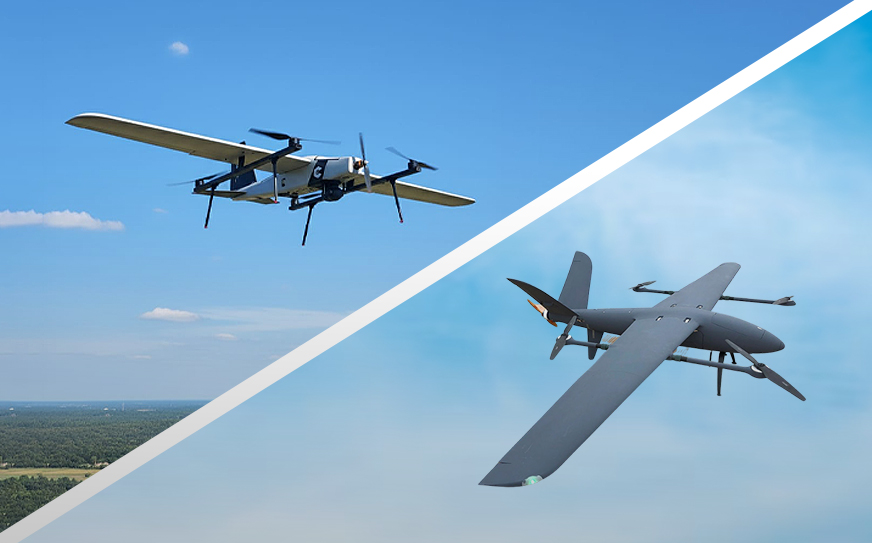
VTOL vs. Fixed-Wing Drone: A Practical Comparison for Long-Range Surveying
Today, survey teams have more options in drones than ever, but one comparison comes up above most others in technical discussions: VTOL versus fixed-wing drone systems. Both types of platforms were designed for large-area mapping and long-distance data collection but tend to perform very differently out in the field. Understanding those differences can help professionals select the right aircraft for each type of terrain, project size, and field environment.
The article discusses the strengths and limitations of both types, not from a promotional angle but from practical and on-the-ground surveying perspectives.
Fixed-Wing Drones: The Traditional Long-Range Workhorses
Fixed-wing drones fly by the same basic aerodynamic principles as small airplanes: once forward momentum is achieved, the wings provide lift, enabling them to travel long distances using minimal energy. This naturally makes them well-suited for long-distance flights.
Items that may be commented on by surveyors who have worked with fixed-wing models are as follows:
It can fly longer with one battery compared with other kinds of drones.
They can cover huge areas in one flight at higher cruising speeds.
These tend to create very smooth, straight mapping lines.
But there is another side, too. Fixed-wing drones require space both for taking off and landing: some need a catapult launcher, others have to land on their bellies on a strip of open land. In rough or forested terrain, it is hardly imaginable to find such a spot, and the landing mishaps are quite common.
VTOL Drones: The Hybrid Option
VTOL drones were designed to solve precisely that problem. These drones take off and ascend vertically, like a multirotor, then transition into forward flight, like a fixed-wing aircraft. For survey teams working in mountains, quarries, dense vegetation or on construction sites, this hybrid approach can be a major advantage.
Those who work with the VTOL system commonly refer to:
They do not require any runway or launching equipment.
Skis enable an airplane to take off from rough terrain, small clearings, and even the bed of a truck.
There is very little possibility of a crash because the landings are controlled and predictable.
That’s a trade-off, because VTOLs in general tend to be more power-consuming during takeoff and landing; that means although their forward-flight endurance is good, it may not match up to that of a dedicated fixed-wing platform.
VTOL versus Fixed-Wing Drone: Side-by-Side Comparison
What follows is a more realistic comparison, based on actual performance, for these drones in long-range surveying situations.
1. Flight endurance and coverage
Fixed-Wing:
This is where fixed-wing drones really excel. It is the aerodynamic efficiency of the models that adds a great deal to improved flight endurance. For large agricultural fields, coast mapping, or extended corridors such as roads and pipelines, nothing beats a fixed-wing drone in its capability to fly over very long distances without using up too much power.
VTOL:
The modern designs of VTOL drones aren’t that far behind, though. Once in forward flight, they fly almost like fixed-wing aircraft; the vertical phases take more energy, so if ultimate range is most important, then fixed-wing still has a slight advantage.
2. Ease of Takeoff and Landing
Fixed-Wing:
This is your largest limitation: If your site sits in a valley, between trees, on a rocky patch, or inside a construction zone, you may find it tough to get a fixed-wing drone into the air. Hard landings also run a greater risk of damage.
VTOL:
This category wins here outright, as the capability to take off vertically from nearly anywhere is highly valued in real survey conditions; this saves time spent on setup and makes the whole operation smoother.
3. Data Quality and Survey Accuracy
In fact, both can carry the same mapping sensors, be it in the form of RGB cameras, multispectral payloads, or LiDAR, and thus core data quality does not depend on drone type.
But flight behavior does matter:
Fixed-Wing:
– To fly at a uniform speed.
Draw straight, even lines
Best for large, uniform areas
VTOL:
can slow down more easily.
More adaptable to uneven terrain.
Handle tight turns with more control
Both yield great results in surveying, with VTOL drones allowing more control to the pilot in adverse landscapes.
Winner: Tie—depends on the terrain.
4. Level of Skill and Learning Curve
Fixed-Wing:
These are drones that require further experience. One needs to know from which direction the wind is coming, keep minimal speeds, and plan for safe landing spots. Field experience will even matter on automated systems.
VTOL: Much easier for newer operators because takeoff and landing are vertical, there’s far less that can go wrong. Winner: VTOL-easier for beginners.
5. Maintenance and Wear Fixed-Wing:
Conclusion
Fewer motors and moving parts mean they are mechanically simpler and usually easier to maintain. However, in contrast, belly landings do sometimes damage the airframe and add its own kind of long-term cost.
VTOL: More parts, more motors-the equation increases in complexity. Maintenance could be higher, but smooth landings reduce physical damage.
Fixed-wing—mechanically simpler. Which is better at long-range surveying? The answer totally depends on your working environment:
Choose a Fixed-Wing Drone If: You are usually working in open areas. You’re normally working with long corridors or large, flat regions. Maximum endurance is important to you. You have plenty of open space for safe takeoff and landing.
Choose a VTOL Drone If: Your projects consistently involve mountains, forests, or tight spaces. You work on sites where launch and recovery areas are small. You want smoother ops, with fewer setup requirements. Your team is made up of operators with various experience. Ultimately, the debate of VTOL versus fixed-wing drones isn’t over which one is universally better—it’s over which one fits your mission environment. Both platforms are key to professional surveying, and many teams today even use a mix of the two depending on the job.
Whether it’s fixed-wing precision or VTOL versatility, Aebocode Technologies helps you pick the perfect system for unmatched surveying performance.