

No-Fly Zones and Geofencing: How Drone Pilots Handle Them-A Practical Approach to Safe UAV Operations
November 28, 2025
Fixed-Wing Versus Multirotor Drones in India: What Really Works?
December 24, 2025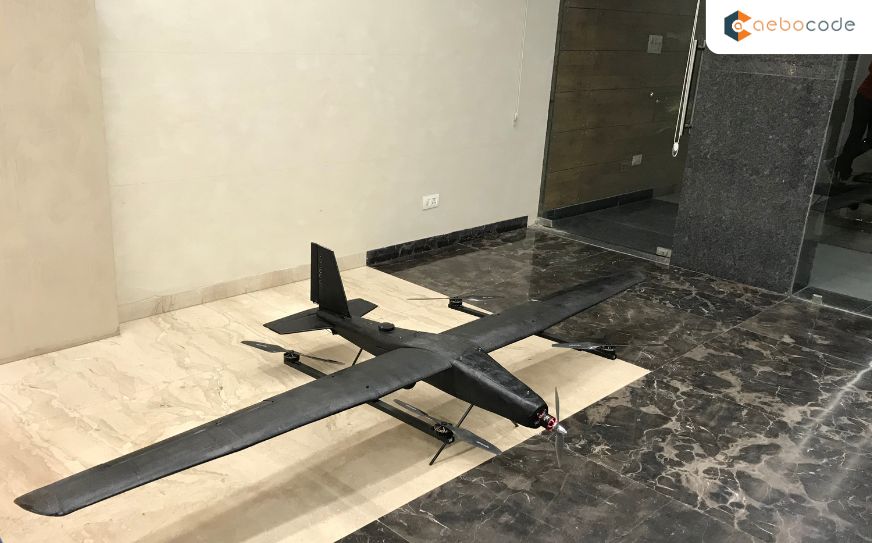
VTOL Drones and Why India Quietly Depends on Them More Than We Admit
In the modern theater of electronic warfare and rapid deployment, the Indian defense sector is going through a quiet but radical shift in its aerial reconnaissance strategy. For years, the military was dependent on large, runway-dependent UAVs or high-maintenance helicopters to monitor our borders. However, in the jagged, high corridors of the Himalayas or the dense thickets like Northeast, “infrastructure” is a luxury that soldiers on the front lines rarely have. The evolution of drones in India is generally framed as a hardware race. However better motors and optics are vital, the true challenge lies in the unpredictability of our environment. Our weather patterns, mountainous borders, and congested urban centers develop a logistical barrier that traditional aircraft struggle to overcome. This is why VTOL (Vertical Take-Off and Landing) defense drones have come out as a game-changer.
The significance of VTOL as a defence drone lies in its simplicity. They have the ability to operate in confined spaces without the requirement for launch rails or runways. It provides the long-range endurance of a plane with the pinpoint landing precision of a helicopter. For India, VTOL isn’t just an impressive engineering feat; it is a real and practical solution to our geographic constraints. By allowing machines to reach the unreachable, VTOL is quietly becoming the infrastructure upon which India’s future aerial logistics will be built.
What is VTOL and Why Does India Need It?
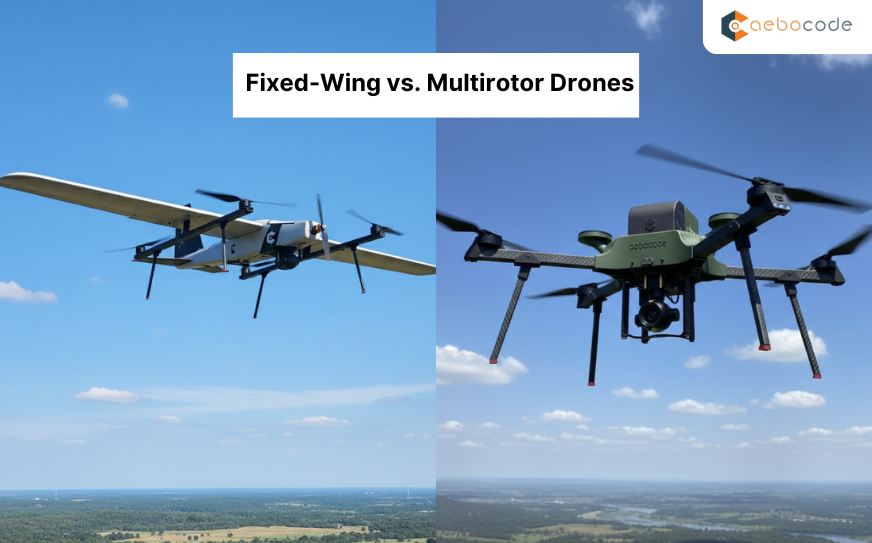
Being one of the defence drone manufacturers in India we can say that VTOL drones are the combination of the best of both worlds. It has the hovering capability and takeoff ease of a helicopter (multirotor) with the high-speed, long-range precision and efficiency of an airplane (fixed-wing).
In the context of the Indian landscape, VTOL fixes three major problems:
1. Zero Infrastructure Dependency: The “Anywhere” Aviation
Let’s take an example of a flood-hit village in Bihar. A landslide-blocked route in Uttarakhand, or a remote military outpost in Ladakh, the luxury of a 50-meter clear runway simply does not exist. In this case traditional fixed-wing drones, despite their speed, are often sidelined in these scenarios because they need launch rails or paved strips.
VTOL drones have the ability to redefine the “landing zone.” They need only a 2×2 meter patch of level ground; they transform any rooftop, forest clearing, or truck bed into a makeshift airport. This makes them the ultimate tool for “last-mile” emergency response. When time is the difference between life and death—such as delivering anti-venom to a remote village or blood units to a disaster zone—the ability to descend vertically into a confined space is not just a technical feature; it is a life-saving necessity.
2. Mastering the “Messy” Urban Grid: Precision in the Chaos
Congested urban environments like the Tricity (Chandigarh, Mohali, Panchkula) present a unique paradox: high demand for rapid delivery but zero space for traditional aerial maneuvers. In these “messy” urban grids, sky-space is cluttered with power lines, high-rises, and communication towers, while ground space is consumed by traffic and infrastructure.
Defence drones like VTOL technology allows for precision-guided vertical insertion. Fixed-wing drones that need to circle a target to lose height (requiring a wide “approach path”). However a VTOL drone has the ability to hover and descend straight down with GPS-aided accuracy. This helps as surveillance drones for seamless surveillance of crowded sectors or the delivery of high-priority documents between IT Park Mohali and Chandigarh Sector 17 without requiring a dedicated landing pad. By navigating the complexities of urban geometry, VTOL drones offer a solution that respects the density of Indian city planning.
3. The Aerodynamic Paradox: Battery Efficiency vs. Operational Range
The fundamental weakness of standard multi-rotor quadcopters (the kind used for wedding photography) is physics. They must constantly fight gravity by pushing air downwards, consuming massive amounts of battery power just to stay airborne. This limits their operational radius to a few kilometers—hardly enough for a country as vast as India.
Many defence drone manufacturers in India depict that VTOL drone achieves this through a brilliant aerodynamic “flip.” It takes off using its rotors, but once it reaches a certain height, it transitions into horizontal flight. For that it uses its wings to generate lift. In this “fixed-wing mode,” the motors only need to provide forward thrust, which is significantly more energy-efficient. This transition lets VTOL platforms cover 10x the distance of a regular drone on a single charge. Whether it is patrolling hundreds of kilometers of border security in the desert or managing cross-city medical logistics, VTOL provides the endurance needed for India’s massive scale.
Also Read:What makes a training drone effective to build pilot skills?
The Quiet Dependence
While the public often associates drones with wedding photography or small toy quadcopters, India’s core sectors—Defense, Agriculture, and Healthcare—are quietly becoming dependent on VTOL.
Whether it is delivering life-saving vaccines to the hilly terrains of the Northeast or monitoring infrastructure in the Western Ghats, the ability to fly straight up and then travel far is no longer optional. It is the backbone of the “Drone Shakti” mission.
Also Read: VTOL vs. Fixed-Wing Drone: A Practical Comparison for Long-Range Surveying
Final Thoughts
We need to stop seeing drones as just flying computers or devices. In India, they are geographic problem-solvers. The transition to VTOL architecture is a recognition that for technology to succeed in India, it must respect our land.
VTOL doesn’t just represent advanced engineering; it represents a machine that finally understands the Indian terrain.